Concrete Slab vs Pavers: Which Lasts Better?
A driveway that settles wrong or a patio that starts looking tired after a few winters becomes expensive fast. That is why the concrete slab vs pavers decision deserves more than a quick price comparison. Homeowners usually start with appearance, but the better question is how the surface will perform under traffic, weather, drainage, and years of use.
For most residential projects, both materials can work well when the base is built properly and the installation is handled by an experienced contractor. The difference is in how they carry weight, how they age, how they are repaired, and what kind of maintenance you are willing to take on. If you are replacing a driveway, building a patio, or upgrading a front walkway, here is how to think about the choice in practical terms.
Concrete slab vs pavers: the core difference
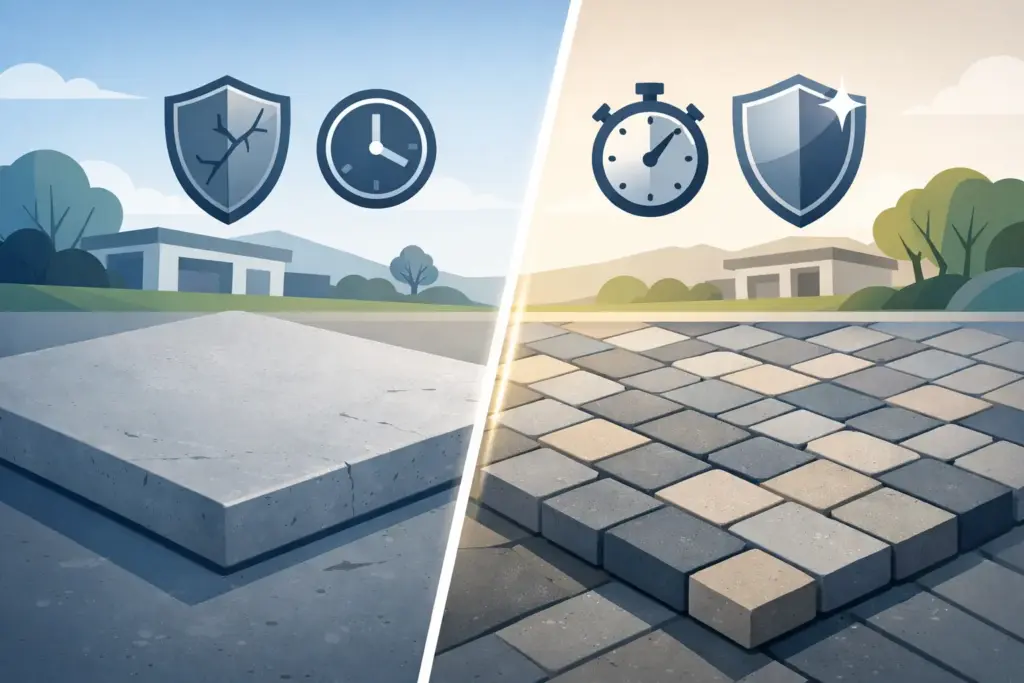
A concrete slab is a continuous poured surface. Once formed, reinforced, and finished, it creates a solid plane that works well for driveways, sidewalks, patios, porches, and other exterior flatwork. It can be broom finished for traction, exposed aggregate for texture, or decorative with stamped patterns and color.
Pavers are individual units laid over a compacted base, usually with sand between the joints. Instead of acting as one continuous piece, the surface works as a system of many pieces fitted together. That gives pavers a different look and a different repair path if one section shifts or gets damaged.
On the surface, this sounds simple. In real projects, the better option depends on where the installation is going, how much traffic it will carry, and whether the homeowner values a monolithic clean finish or a more segmented decorative look.
Cost is not the whole story
If budget is driving the conversation, a concrete slab is often the more cost-effective option up front. For larger areas especially, poured concrete usually gives homeowners more coverage for the money. That makes it a strong choice for driveways, side paths, backyard slabs, and practical outdoor living spaces where durability matters more than intricate patterning.
Pavers generally cost more to install because the process is more labor intensive. There is more layout work, more individual placement, more cutting, and more edge restraint detail. Material pricing can also climb quickly depending on the paver style and thickness.
That said, the cheapest installation is not always the best value. A poorly poured slab with a weak base will crack and settle. A poorly installed paver system will shift, spread, or create trip hazards. The real value comes from proper excavation, base prep, grading, and workmanship. That is where projects either hold up or fail early.
Appearance and curb appeal
This is where homeowner preference plays a major role. A concrete slab gives a cleaner, more continuous look. It works well with modern homes, traditional homes, and properties where a neat, solid finish fits the architecture. Decorative concrete also gives you more design flexibility than many people expect. Stamped concrete can mimic stone, brick, or tile patterns while keeping the benefits of a single poured surface.
Pavers have a more textured, modular appearance. Some homeowners prefer that because it feels high-end and custom. Pavers can create strong visual contrast, borders, and patterns that stand out in a patio or front entry area.
Neither option wins on looks across the board. It depends on the home, the surrounding hardscape, and whether you want the finish to blend in or make more of a design statement.
Durability under real use
For driveways and high-use exterior areas, durability is usually the deciding factor. A properly installed concrete slab has excellent compressive strength and can handle regular vehicle traffic well. It is a dependable option for homeowners who want a strong, long-lasting surface with straightforward maintenance.
Pavers are also durable, but they behave differently. Because they are made of individual units, they can flex slightly with minor movement in the base. That can be an advantage in some conditions. The downside is that if the base work is not done right, pavers can begin to shift, settle unevenly, or develop low spots over time.
Freeze-thaw cycles matter too. In areas with harsh winters, both systems need proper drainage and base preparation. Water is the real enemy. If water sits under a slab, it can contribute to cracking and heaving. If water undermines pavers, sections can settle and lose their alignment. Good installation matters more than marketing claims.
Repairs and long-term maintenance
This is one of the clearest trade-offs in the concrete slab vs pavers comparison.
If a concrete slab cracks, repairs are possible, but the surface usually will not look brand new again. Crack repair can stop deterioration, improve safety, and extend service life, but patching may remain visible. In severe cases, a section may need to be removed and replaced.
Pavers are easier to repair in a localized area. If a section settles or individual units are damaged, those pavers can often be lifted, the base corrected, and the area reset. That makes spot repairs more manageable from a visual standpoint.
Maintenance is different as well. Concrete may need periodic sealing depending on the finish and exposure. It should also be kept clean and free of deicing products that can be too aggressive for the surface. Pavers can require joint sand maintenance, weed control, and occasional resetting if movement develops.
So the question is not which one needs zero maintenance. Neither does. The better question is whether you prefer a simpler surface with fewer joints or a system that allows easier piece-by-piece repair.
Best uses for each option
Concrete slabs are often the better fit for driveways, garage aprons, sidewalks, porches, stairs, basement walkouts, and patios where you want strength, clean lines, and efficient installation. They are especially practical when the area is large or the project needs to balance appearance with budget.
Pavers are often chosen for patios, garden walkways, pool surrounds, and entry areas where decorative impact is a top priority. They can also work for driveways, but that decision should be based on vehicle load, edge restraint, base depth, and overall installation quality.
For homeowners focused on long-term structural performance, concrete often makes more sense in high-load areas. For homeowners focused on detailed design and modular repair, pavers can be attractive. The right answer depends on how the space will actually be used, not just how it looks on day one.
Installation quality decides the outcome
Homeowners sometimes compare materials as if the product alone determines the result. In reality, the contractor and the prep work have just as much impact as the surface itself.
With a concrete slab, the excavation depth, compacted base, reinforcement, control joints, finishing method, and curing all affect lifespan. With pavers, the base thickness, compaction, bedding layer, joint sand, restraint system, and slope control are all critical. If any of that is rushed, the surface may look fine at first and fail early.
That is why experienced installation matters. A good contractor does not just ask what looks nicest. They ask where water will go, how the grade changes across the property, what kind of traffic the area will carry, and how the new surface ties into steps, garages, foundations, or existing masonry.
Which one is better for your property?
If you want a cost-effective, durable, low-fuss surface for a driveway, walkway, porch, or patio, a concrete slab is usually the stronger overall value. It gives you structural reliability, design flexibility, and a clean finish that suits most homes.
If your priority is a more decorative layout with the ability to replace individual sections later, pavers may be worth the extra investment. They can look excellent when installed correctly, especially in outdoor living spaces where style leads the decision.
For many homeowners, this comes down to one simple point. If the project is primarily functional, concrete usually wins. If the project is primarily decorative, pavers become more appealing. But there is plenty of overlap, and some of the best projects combine strong construction with a finished look that fits the home.
At Sampson Concrete & Masonry, that is how we approach exterior work - not with one-size-fits-all advice, but with honest recommendations based on use, drainage, durability, and finish. The best surface is the one that still performs years from now, after the weather, traffic, and daily use have had their say.
Before you choose, think past the sample board. Look at how the area functions, what kind of maintenance you want to deal with, and how long you expect the investment to serve your property. The right choice is the one that holds up well and still looks right when the new-project shine is long gone.