What Causes Driveway Surface Scaling?
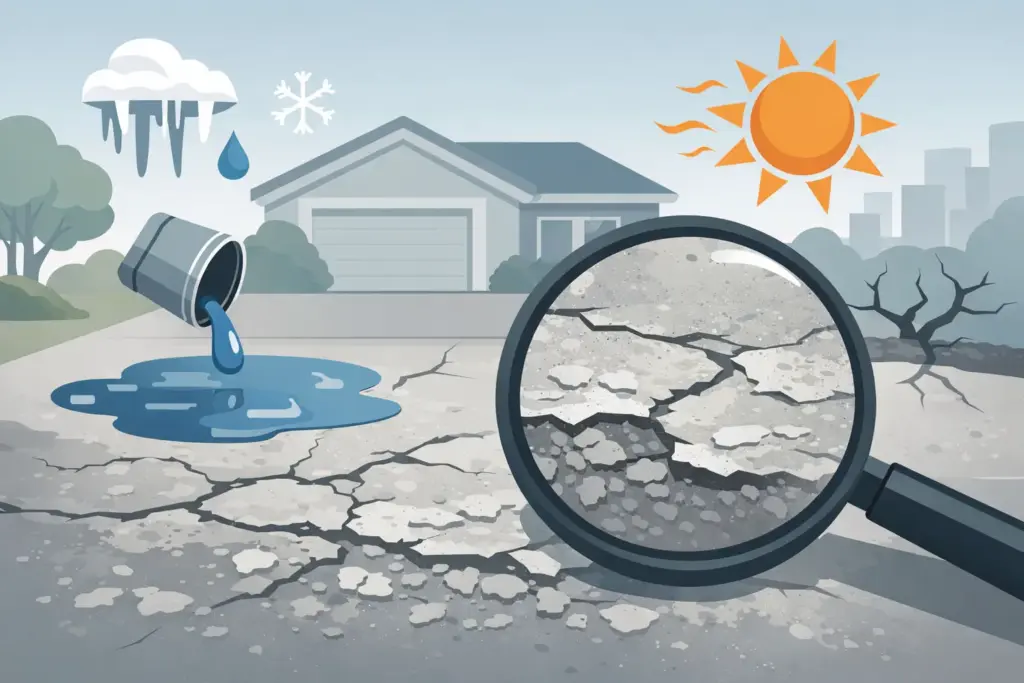
A driveway should not start flaking, pitting, or shedding its top layer after a few winters. When that happens, homeowners usually ask the right question right away: what causes driveway surface scaling? The short answer is moisture, cold weather, and surface weakness working together. The bigger answer is that scaling usually points to a problem in the concrete mix, the finishing process, the curing stage, or the way the surface has been exposed to water and deicing salts over time.
What causes driveway surface scaling in concrete?
Surface scaling is the loss of the concrete's top layer. It often starts as light flaking or shallow peeling, then grows into rough patches, exposed aggregate, and a worn-looking finish. In some cases, it stays cosmetic for a while. In others, it opens the door to faster deterioration because water can penetrate more easily once that protective surface is gone.
Most driveway scaling does not come from one single mistake. It is usually the result of several conditions lining up at once. Freeze-thaw cycles are a major factor, especially in colder climates where driveways take constant weather exposure. Water gets into the surface, freezes, expands, and creates pressure. If the top layer is already weak, it starts to break apart.
Deicing salt makes that process worse. Salt increases moisture exposure and adds chemical stress at the surface. That does not mean every salted driveway will scale, but a driveway with poor finishing or improper curing is much more likely to fail when winter conditions hit.
The most common reasons scaling happens
One of the biggest causes is a weak surface created during finishing. Concrete has to be worked carefully while it is setting. If too much water is added at the surface, or if the slab is finished while bleed water is still present, the top layer can become soft and porous. It may look smooth when the job is done, but that thin top skin is not durable enough to hold up through weather and vehicle traffic.
Overworking the surface can create the same problem. A driveway needs proper finishing, not excessive manipulation. If the cement paste is brought up too heavily or the slab is troweled in a way that traps water and fines at the top, the finished face can end up weaker than the body of the slab underneath.
Poor curing is another major issue. Fresh concrete needs time and moisture control to gain strength properly. If it dries out too fast, especially in hot sun, wind, or low humidity, the surface can lose strength before it fully develops. That weakened outer layer may not show immediate damage, but winter often exposes it.
Low air entrainment also plays a big role in cold-weather performance. Exterior concrete in freeze-thaw climates generally needs properly entrained air to create microscopic spaces that relieve pressure when water freezes inside the slab. Without that internal protection, the surface is far more vulnerable to scaling.
Then there is the water issue itself. Concrete that stays wet more often is at higher risk. Poor drainage, low spots, downspout discharge onto the driveway, and snow piles that melt and refreeze in one area all increase stress on the slab. Even a well-poured driveway can wear faster if water consistently sits on it.
Why salt causes so much damage
Homeowners often assume salt is the only culprit. It is a factor, but it usually acts like an accelerator rather than the sole cause. When deicers are used on concrete that is new, poorly cured, or already surface-weakened, scaling can happen fast.
The first winter is especially important. New concrete is more vulnerable before it has fully matured. Strong deicing chemicals applied too early can damage the surface before it has had a fair chance to perform. Calcium chloride and similar products can be especially harsh depending on the age and condition of the slab.
That said, not all winter products affect concrete the same way, and not all damage is immediate. Sometimes scaling shows up after repeated seasons of exposure. What matters most is whether the driveway had the strength, finish quality, and curing it needed from the start.
Installation mistakes that can lead to scaling
A lot of surface failures trace back to the day the driveway was poured. If the concrete mix has too much water added on site, strength drops. If finishing starts too soon, bleed water gets worked back into the surface. If curing is rushed or skipped, the slab may look acceptable at handoff but lack long-term durability.
Weather conditions during installation matter too. Pouring in very hot, windy, or cold conditions without adjusting the process can lead to trouble. Concrete is not forgiving when timing is off. A driveway needs the right mix, proper base preparation, correct placement, careful finishing, and real curing discipline. Miss one step, and the top layer may pay for it later.
Thickness and base support matter more for cracking and settlement than scaling alone, but they still affect the slab's overall performance. When a driveway flexes or holds water because the base was poorly prepared, surface wear tends to accelerate.
What causes driveway surface scaling after only one or two winters?
When a newer driveway starts scaling quickly, that usually points to an early-life problem rather than ordinary age. The concrete may have been finished with excess surface water, cured poorly, exposed to deicers too soon, or placed with a mix that was not ideal for exterior freeze-thaw use.
This is where homeowners get frustrated, and fairly so. A driveway is a major investment. It should not start breaking down almost immediately. Fast scaling is often a sign that the slab did not get the craftsmanship it needed at installation. In some cases, the damage can be managed with surface repair. In more severe cases, replacement is the smarter long-term choice because patching a weak top layer does not always solve the underlying issue.
How to tell scaling apart from other concrete damage
Scaling is surface loss. You will usually see flakes, chips, shallow peeling, or a sandy, worn top layer. It often spreads across high-exposure areas where water sits or salt is used most often.
That is different from deeper spalling, where larger sections break away, sometimes exposing coarse aggregate more aggressively or even revealing reinforcing material in structural concrete. It is also different from normal hairline shrinkage cracks, which may be cosmetic and not involve surface peeling.
Discoloration, pop-outs, and pitting can sometimes appear alongside scaling, which is why a proper site assessment matters. The right repair depends on whether the problem is only at the surface or tied to broader slab failure.
Can driveway scaling be prevented?
Yes, in many cases it can. Prevention starts with quality installation. The concrete needs the right mix design for exterior exposure, proper air entrainment, a well-prepared base, correct finishing, and full curing. Those are not upgrades. They are fundamentals.
After installation, maintenance matters too. Keep water from draining onto the driveway unnecessarily. Avoid using harsh deicers on new concrete. Remove snow with equipment that will not gouge the surface. If sealing is appropriate for the slab and local conditions, do it on the right schedule with the right product rather than as a quick cosmetic fix.
It also helps to watch for early warning signs. If you notice light flaking, roughness, or small surface pits, it is worth having the driveway checked before damage spreads. Small issues are easier to manage than broad surface failure.
When repair makes sense and when it does not
Minor scaling can sometimes be addressed with professional surface repair methods, especially if the slab underneath is sound. The key is proper preparation and realistic expectations. A thin cosmetic coating over unstable concrete will not last.
If scaling is widespread, deep, or combined with cracking, settlement, or drainage problems, replacement may be the better investment. That is not always what homeowners want to hear, but it is often the honest answer. Durable concrete work depends on sound construction from the ground up, not just a good-looking finish on top.
For property owners who want a driveway that holds up, this is where experienced trade work matters. A contractor should be thinking beyond the pour day and focusing on base prep, weather conditions, curing, drainage, and long-term performance. That is how you protect appearance, function, and property value at the same time.
If your driveway is starting to flake or pit, the best next step is not guesswork. Get the surface evaluated, find the real cause, and fix it the right way before one rough winter turns into a much bigger repair.