How to Choose Patio Concrete
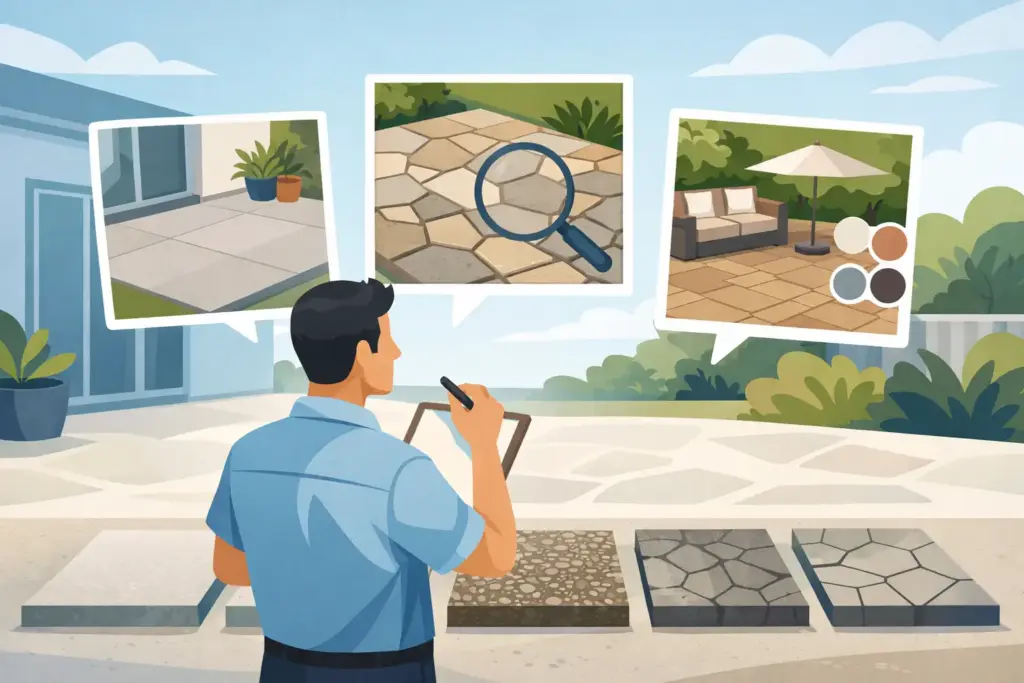
A patio can look great on day one and still be the wrong choice for your property. That usually happens when homeowners focus on color or pattern first and only find out later that the slab holds water, cracks too soon, or feels out of place with the house. If you are figuring out how to choose patio concrete, the best approach is to start with performance, then work your way to appearance.
A concrete patio is not just a flat surface in the backyard. It is an exterior structure that needs to handle weather, drainage, foot traffic, outdoor furniture, and seasonal movement. If it is installed properly and matched to the way you use the space, it adds real value and gives you a low-maintenance area that lasts.
How to choose patio concrete for your property
The right patio concrete depends on three things at the same time: how the patio will be used, what the site conditions are, and how much finish detail you want. A simple broom-finish patio for grilling and patio furniture has different demands than a decorative stamped concrete patio meant to anchor a full outdoor living area.
This is where many homeowners get tripped up. They ask which concrete is best, but there is no one-size-fits-all answer. The better question is which patio system fits your home, layout, drainage needs, and budget without sacrificing durability.
If your yard has slope, poor drainage, or soft ground, that matters just as much as the finish you choose. If the patio will support a pergola, outdoor kitchen, or hot tub area nearby, that also changes how the slab should be planned. Good concrete work starts well before the pour.
Start with the base, not the surface
Most patio problems do not begin at the top. They begin underneath. Even strong concrete can fail early if the subgrade is unstable or the base is not prepared correctly.
A proper patio installation needs a solid, compacted base that supports the slab evenly. Without that support, sections can settle, shift, or crack beyond normal hairline movement. In freeze-thaw climates, poor preparation shows up fast.
This is why the cheapest quote is not always the best value. A contractor can make a patio look finished quickly, but if they cut corners on excavation, grading, base material, or compaction, you may be paying for replacement much sooner than expected. When you choose patio concrete, you are also choosing the installation standard behind it.
Think about thickness and strength
For a standard residential patio, four inches is common, but that does not mean every four-inch slab performs the same way. Concrete mix design, reinforcement, base prep, and joint placement all affect long-term results.
If the patio will carry heavier loads or connect to structures and stairs, the design may need to be adjusted. Reinforcement can help control cracking, but it does not replace proper site preparation. Concrete naturally cracks to some degree. The goal is not to pretend cracks never happen. The goal is to control where they happen and make sure the slab stays sound and serviceable.
This is one of the more important trade-offs to understand. Decorative patios often get the attention, but structural reliability has to come first. A plain patio that drains well and stays stable is a better investment than a high-end finish installed over poor groundwork.
Drainage is not optional
A patio should shed water away from the home, not hold puddles against the foundation or send runoff toward basement access points. Slope is part of good patio design, and it needs to be planned before forms are set.
Homeowners sometimes worry that proper drainage will make the patio feel uneven. It should not. When done right, the pitch is subtle and functional. You notice the comfort of the surface, not the slope itself.
If your property has low spots, heavy runoff, or grading issues, those conditions should be handled as part of the project, not ignored. This is especially important if the patio sits near a walkout, porch, steps, or retaining features. A patio that looks level but traps water is a problem waiting to happen.
Choose the finish based on use and maintenance
When people ask how to choose patio concrete, they are often really asking which finish they should pick. That matters, but the answer depends on how you want the patio to perform every day.
A broom finish is one of the most practical options. It gives you slip resistance, a clean look, and solid durability without pushing the budget too high. For many homeowners, that is the right call because it delivers function first.
A stamped concrete patio offers more visual impact. It can mimic stone, brick, or tile and create a more customized outdoor space. Done well, it can significantly improve curb appeal and backyard design. But it also requires more precision during installation and more attention to sealing and upkeep over time.
Exposed aggregate is another strong option if you want texture and a decorative finish without the look of stamped patterns. It tends to hold traction well and can work nicely in homes that need a more natural exterior style.
There is no wrong choice if the finish fits the property and the homeowner's expectations. The mistake is choosing a decorative surface without understanding the maintenance involved or selecting a plain finish when the entire project is meant to upgrade the look of the yard.
Color and style should match the house
Concrete gives you more design flexibility than many homeowners expect. You can keep it simple, add integral color, use borders, or create a stamped pattern that ties into existing masonry, steps, or walkways.
The key is restraint. A patio should complement the home, not compete with it. Warm earth tones usually age better than trendy shades. Patterns should suit the scale of the space. If the house is traditional, a natural stone look may fit better than a bold geometric pattern. If the exterior is cleaner and more modern, a simple finish with sharp edges often works better.
A good patio feels like it belongs there. That is what separates custom-looking work from something that feels dropped into the yard without a plan.
Budget matters, but value matters more
Every homeowner has a budget. That is normal. But patio pricing should be judged against scope, preparation, finish level, and expected lifespan, not just the bottom-line number.
A lower-cost patio may leave out base depth, reinforcement, grading corrections, border work, or sealing. On paper, it looks like savings. In reality, it can mean more risk and a shorter service life. A better-built patio often costs more because more work goes into doing it right.
This does not mean you need the most expensive option. It means you should be clear about what you are paying for. Ask what is included in excavation, base prep, thickness, control joints, finish, cleanup, and warranty coverage. A dependable contractor should be able to explain that in plain language.
Ask the right questions before you hire
The contractor you choose has as much impact as the concrete itself. A well-planned patio needs experienced layout, careful forming, proper finishing, and attention to curing conditions.
Ask how the base will be prepared, how drainage will be handled, what finish is recommended for your goals, and what kind of cracking control will be used. Ask whether the design can be customized to fit stairs, walkways, porch transitions, or surrounding masonry. If decorative work is involved, ask to see examples of similar jobs.
You should also ask about warranty coverage and what happens if there is a problem after the project is completed. A company that stands behind its workmanship is usually more invested in getting the details right the first time. That matters.
The best patio concrete is the one built for your yard
Patio concrete is not just about selecting a finish from a sample board. It is about choosing a slab that suits your property, supports how you use the space, and holds up through weather and wear. For one home, that may be a straightforward broom-finish patio with clean edges and strong drainage. For another, it may be a stamped concrete design that upgrades the whole backyard.
At Sampson Concrete & Masonry, that decision starts with the site, the structure, and the long-term result the homeowner wants. That is the difference between a patio that simply gets poured and one that is built to last.
If you are planning a new patio, trust what you cannot see as much as what you can. The finish catches the eye, but the real value is in the workmanship underneath.