Driveway Drainage Solutions That Last
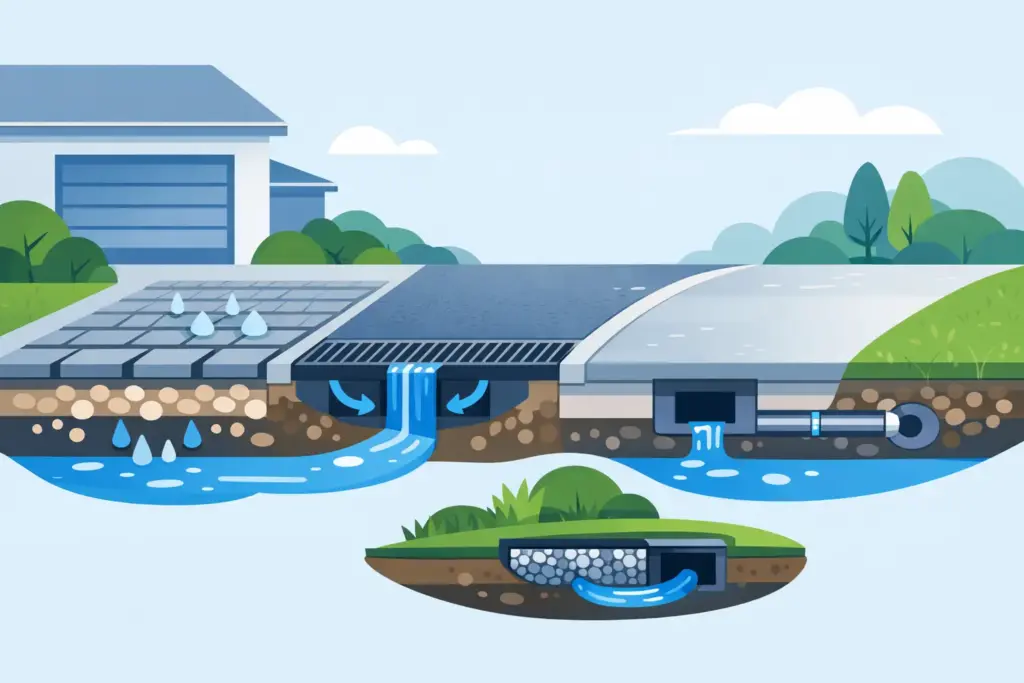
A driveway that holds water is not just annoying after a storm. It is often the first sign that the slope is wrong, the base is failing, or runoff has nowhere to go. The right driveway drainage solutions protect concrete, reduce winter ice, prevent erosion, and help you avoid repair costs that grow year after year.
For most homeowners, the issue starts small. You notice puddles near the garage, water spilling across the walkway, or a soft edge where gravel and soil keep washing away. Then the surface begins to stain, crack, or settle. Drainage problems rarely stay cosmetic for long, especially around concrete and masonry where trapped water can speed up wear.
Why driveway drainage matters more than most homeowners think
Water is one of the main reasons exterior surfaces fail early. When runoff sits on a driveway, it can seep into small cracks, weaken the base underneath, and create movement during freeze-thaw cycles. That is how minor surface issues turn into wider cracks, spalling, uneven sections, and edge breakdown.
Poor drainage also affects more than the driveway itself. Water can wash toward a porch, collect near a foundation, damage nearby landscaping, or create slippery areas where people walk. If runoff is constantly moving in the wrong direction, the problem can spread well beyond the original puddle.
A good drainage plan protects the full investment. It keeps water moving away from structures, preserves the surface, and helps the driveway look clean and finished instead of patched and worn.
Common signs you need driveway drainage solutions
Some drainage issues are obvious, and some hide in plain sight. Standing water after rain is the clearest red flag, but it is not the only one. You may also notice cracks that keep reopening, low spots that collect dirt, washed-out edges, ice patches in winter, or water lines that show where runoff is traveling.
Another common clue is when a driveway looks fine from the street but consistently stays wet longer than surrounding surfaces. That usually points to a grading issue or a section that has settled. If water is draining toward the garage door or foundation wall, the situation deserves prompt attention.
In older driveways, drainage trouble often comes from a mix of age and construction limits. The original slope may have been minimal, nearby landscaping may have changed runoff patterns, or years of use may have compacted and shifted the base.
The best driveway drainage solutions depend on the cause
There is no single fix that works for every property. The right answer depends on the driveway material, the elevation around the home, how much runoff the area receives, and where the water needs to go.
In some cases, a simple grading correction solves the issue. In others, the driveway needs a dedicated collection system to catch water before it pools. If the surface itself is failing, patching around the problem usually buys little time. The drainage and the structure need to work together.
Regrading the driveway surface
If the driveway was installed with poor pitch or has developed low areas over time, regrading may be the cleanest long-term fix. A driveway should direct water away from the house and toward a safe discharge area. When that slope is too flat, even a durable concrete surface can hold water.
Regrading works best when the problem is tied to shape rather than severe structural failure. The trade-off is that minor corrections are possible, but major slope changes may require partial or full replacement to get a proper result. That is often the smarter investment when the existing slab is already cracked or settling.
Trench drains and channel drains
A trench drain, sometimes called a channel drain, is one of the most effective driveway drainage solutions when runoff collects in a predictable line. These systems are often installed near garage entrances, at the bottom of a sloped driveway, or across areas where water would otherwise rush toward the home.
The benefit is control. Instead of hoping water sheets away on its own, the drain captures it and redirects it through a managed outlet. The key is proper placement and installation. A drain that is too shallow, undersized, or poorly tied into discharge piping can clog or overflow, which defeats the purpose.
French drains for runoff control
French drains are useful when water is moving through the surrounding soil as much as over the driveway surface. They collect and redirect groundwater or persistent runoff, especially along driveway edges or lower landscape areas.
They are not always the first choice for surface pooling right on a slab, but they can be very effective when the drainage issue is broader than the driveway alone. If the yard stays saturated and water keeps pushing back toward paved areas, a French drain may need to be part of the overall solution.
Catch basins and area drains
When large volumes of water collect at a low point, a catch basin or area drain may be the better fit. These systems gather runoff quickly and connect to underground piping that moves it away from traffic areas and structures.
This approach works well on properties where the driveway, walkways, and hardscaping all send water to the same location. It is practical, but only if there is a clear discharge path. If the outlet is not planned properly, the system can simply move the problem somewhere else.
Permeable surfaces and drainage-friendly design
In some settings, a permeable driveway surface or a redesign of the surrounding hardscape makes sense. Permeable pavers, open-joint systems, and certain gravel installations allow water to move through rather than sheet across the top.
That said, this option depends heavily on the property and the homeowner's priorities. Permeable systems can help with runoff, but they also require the right base design and ongoing maintenance. For many homes, a properly sloped concrete driveway with targeted drainage features offers a stronger balance of durability, appearance, and ease of care.
When repair is enough and when replacement makes more sense
Homeowners often ask whether drainage can be fixed without replacing the driveway. Sometimes it can. If the surface is structurally sound and the issue is limited to one drainage path, adding a channel drain or correcting adjacent grading may be enough.
But if the slab has multiple low spots, widespread cracking, surface scaling, or signs of base failure, repairing the drainage around it may not solve the larger problem. Water will keep finding weak points. In those cases, replacement gives you the opportunity to rebuild the base, correct the slope, and install drainage features the right way from the start.
This is where experience matters. A good-looking pour is not enough if the water plan is wrong. The driveway has to be built for traffic, weather, runoff, and long-term movement.
What good installation looks like
Proper driveway drainage starts before concrete is poured. The subgrade has to be prepared correctly, the base needs to be compacted, and the slope has to be measured with purpose, not guessed at in the field. Drain components need to be set at the right elevation and tied into a reliable path for discharge.
Clean finishing matters too. The final result should move water without creating awkward transitions, trip points, or weak edges. That balance of function and appearance is what separates a short-term fix from a finished project that adds value to the property.
For homeowners investing in exterior improvements, this is not the place to cut corners. Drainage work hidden underneath or along the edges may not be the most visible part of the job, but it often determines how well the visible parts hold up.
Choosing driveway drainage solutions for your property
The best plan starts with an honest assessment of how water moves across your site. Where does runoff begin, where does it collect, and where can it safely go? A steep driveway has different needs than a flat one. A newer subdivision lot may drain differently than an older property with mature landscaping and changed grading.
That is why the strongest solutions are usually customized. One home may need a trench drain at the garage and a small grading correction. Another may need partial replacement, new concrete, and drainage tied into the surrounding hardscape. The goal is not to add features for the sake of it. The goal is to solve the water issue in a way that lasts.
At Sampson Concrete & Masonry, that kind of work is approached with the same standard as any structural exterior project - solid prep, clean execution, and results built to hold up. If your driveway is pooling water, shifting, or draining toward the house, it is worth addressing before the damage spreads.
A driveway should guide water away, stay safe underfoot, and hold its finish through the seasons. When the drainage is right, the whole surface performs better and the rest of the property benefits with it.